
What Does a Compressed Air Leak Audit Cost, and How Much Can It Save a Central Virginia Facility?
PVC can shatter under compressed air. Here is what the OSHA record says and how VA Commercial Repair Solutions replaces it with RapidAir piping.
VA Commercial Repair Solutions is a Class A mechanical contractor in Fishersville, Virginia. We repair and maintain air compressors, and we are the local RapidAir factory representative and installer of compressed air piping.
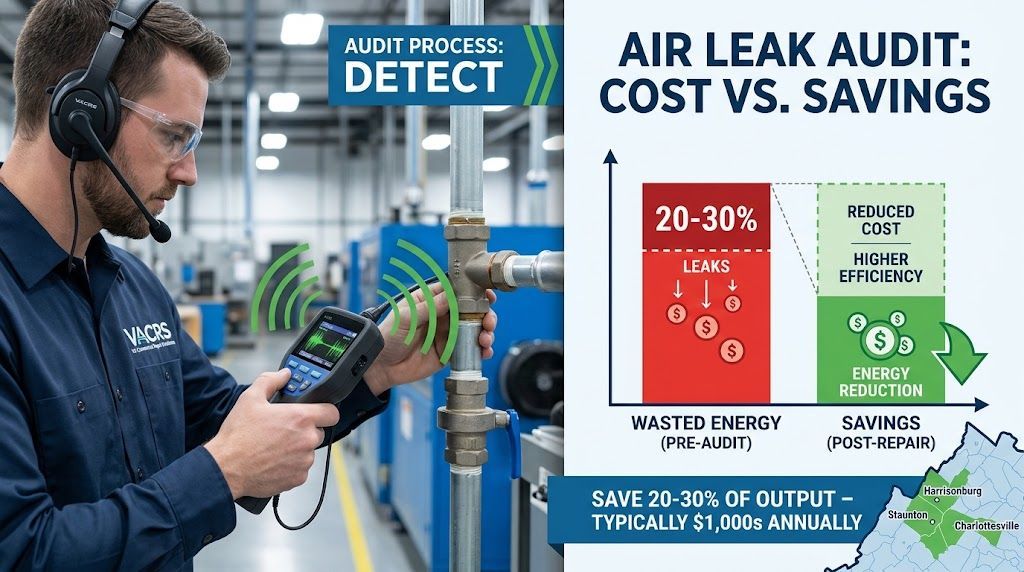
A compressed air leak audit usually costs far less than the leaks it finds. The U.S. Department of Energy reports that leaks often waste 20 to 30 percent of a compressor's output. Picture your compressor running 20-30% less and lasting at least that much longer. Published audit pricing ranges from a few hundred dollars for a small shop to five figures for a full engineering study. This guide reflects pricing and energy guidance available as of September 2026.
What Is a Compressed Air Leak Audit?
A compressed air leak audit is a very transparent examination of your entire compressed air system where we find, tag, and quantify every leak. VA Commercial Repair Solutions offers this service as our Air System Maintenance Audit, listed on our commercial air compressor repair page.
An audit typically includes four parts:
- Ultrasonic air leak detection. Escaping air makes a high-frequency hiss that ultrasonic detectors pick up even on a noisy floor. The DOE Compressed Air Tip Sheet #3 calls ultrasonic detection the best way to find leaks. Soapy water works to a lesser degree, and is slower and much messier.
- Tagging and sizing. Each leak is tagged, located, and estimated by size so the largest get fixed first.
- Pressure and flow logging. Data loggers show how much air the system uses and where pressure drops.
- Supply-side review. The compressor, dryer, and controls are checked, because fixed leaks only save money if the compressor runs less.
How Much Does a Compressed Air Leak Audit Cost?
Published audit pricing varies widely, so this section names each source. VA Commercial Repair Solutions quotes each facility individually.
- Foresight Management, a national energy services firm, states that its compressed air leak studies often run $0.02 to $0.08 per square foot. That is Foresight's own pricing.
- Air Compressor Zone, a compressor industry publisher, puts a full engineering-level compressed air system audit at $5,000 to $25,000 for complex multi-compressor plants. That is the publisher's estimate, not independent research.
Four factors drive the price: floor area, the number of compressors, the number of drops and connections, and whether you need a leak survey only or full flow metering.
For a 20,000 square foot facility, Foresight's published rate works out to roughly $400 to $1,600. Most small and mid-sized Central Virginia shops need a leak survey and system check, not a Level 3 engineering study.
To get a quote for your facility, call VA Commercial Repair Solutions at (540) 457-4822, (866) 729-2215 or request a free quote online.
How Do You Estimate What Leaks Cost Your Facility Each Year?
The DOE publishes a simple formula for this. Here it is, with a worked example for a typical Shenandoah Valley Virginia shop.
Annual cost = number of leaks × leak rate (cfm) × 0.18 kW per cfm × operating hours × electric rate
Worked example. Assume a single-shift shop running 2,500 hours a year. We used $0.12 per kWh as an illustrative rate. Use the rate on your own utility bill, because rates differ between Dominion Energy, the local cooperatives, and municipal utilities.
- 30 leaks of 1/32 inch: about $1,532 a year
- 20 leaks of 1/16 inch: about $4,157 a year
- 1 leak of 1/4 inch: about $3,324 a year
- Total: about $9,013 a year. A two-shift shop would lose about $18,000.
One quarter-inch leak costs nearly as much as twenty small ones. The DOE's own example found that ten 1/4-inch leaks made up almost 70 percent of a chemical plant's $57,069 in savings. VA Commercial Repair Solutions fixes the largest leaks first for that reason.
What Does a Typical Leak Audit Find?
Most audits find more leakage than the owner expected. The Compressed Air Challenge fact sheet on the cost of leaks says a poorly maintained plant will likely leak about 20 percent of its capacity. A proactive leak program can bring that under 10 percent.
The DOE tip sheet lists the usual leak points:
- Couplings, hoses, and quick disconnects
- Fittings, pipe joints, and thread sealants
- Filter, regulator, and lubricator units
- Condensate traps, valves, and point-of-use devices
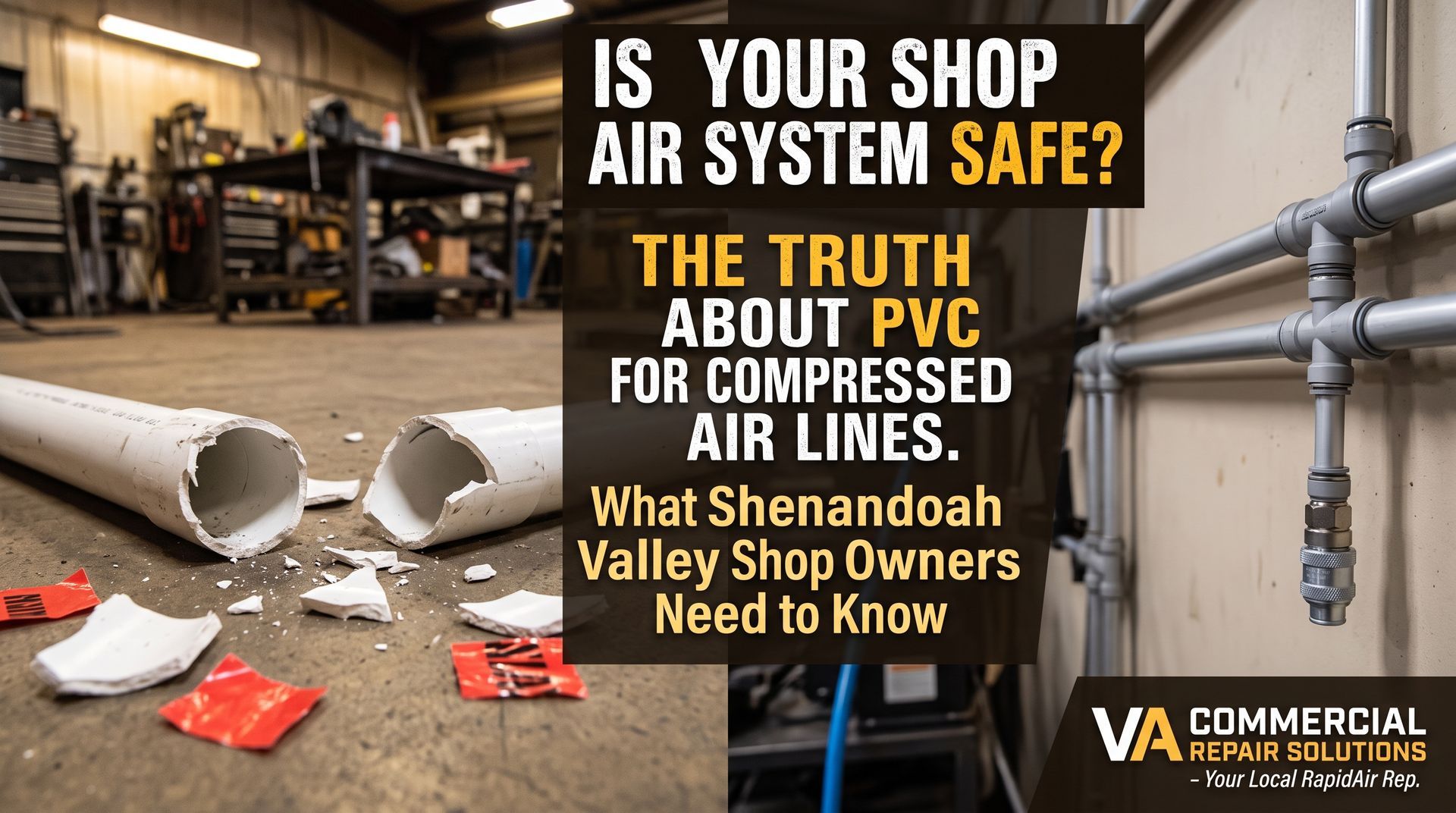
Some systems are far worse than average. Compressed Air Best Practices magazine reports that experienced auditors commonly see leakage above 80 percent in some plants. Aging PVC or black iron air lines add risk, which VA Commercial Repair Solutions explains in our guide to RapidAir compressed air piping for Central Virginia shops.
Why Does a Leak Audit Look at the Compressor Too?
Leaks are only part of the energy picture. VA Commercial Repair Solutions checks the compressor during every Air System Maintenance Audit because that is where your money is actually spent or wasted.
Three facts from public energy agencies explain why:
- The Bonneville Power Administration compressed air efficiency sheet says only 10 to 20 percent of a compressor's electric input reaches the point of use.
- The New Hampshire Department of Environmental Services compressed air guide says an idling compressor uses around 40 percent of its full-load energy.
- The DOE advises adjusting compressor controls after leaks are repaired, so run time falls to match the lower demand.
Our air compressor preventive maintenance service covers oil, belts, air filters, and desiccant filters, which keep the compressor efficient between audits.
How Does a Local Audit Compare With a Distributor Audit?
Several compressed air distributors serve Central Virginia from outside the Staunton, Harrisonburg, and Charlottesville area:
- Lewis Systems serves Virginia from its Lynchburg branch.
- Quincy refers Charlottesville buyers to an authorized partner in Richmond.
- Cummins-Wagner and C.H. Reed list Staunton and Harrisonburg among their service cities. Cummins-Wagner offers on-site air audits with meters and data loggers.
These firms are a strong fit for large plants with several compressors that want a full engineering study or a new compressor purchase.
VA Commercial Repair Solutions fits all buyers: small, mid-sized and large facilities that want one team to find the leaks, fix them, and maintain the system. We have repaired and installed commercial air compressors for more than 10 years. We work on oil-free and lubricated units from 5 to 600 HP, across all major brands. We also handle related industrial machine repair and preventive maintenance.
For clients who want one contractor for the whole building, our one-stop facility maintenance program covers HVAC, refrigeration, electrical, and mechanical systems together.
What Happens After a Compressed Air Leak Audit?
The audit is only worth its cost if the leaks get fixed and stay fixed. The DOE recommends an ongoing leak prevention program with tagging, tracking, repair, and verification. It sets a reasonable target of 5 to 10 percent of total system flow.
After an audit, VA Commercial Repair Solutions:
- Repairs tagged leaks, starting with the largest
- Replaces failing PVC or corroded black iron runs with RapidAir aluminum piping
- Sets up scheduled compressor maintenance
- Rechecks the system after the repairs to confirm the savings
VA Commercial Repair Solutions is SWAM certified, an eVA certified provider, and a Class A contractor under Virginia license 2705180394. Learn more about our Fishersville team or contact VA Commercial Repair Solutions to schedule an Air System Maintenance Audit.
Frequently Asked Questions
How much does a compressed air leak audit cost?
Published pricing varies. Foresight Management states that its leak studies often cost $0.02 to $0.08 per square foot. Air Compressor Zone puts full engineering audits for complex plants at $5,000 to $25,000. Most small and mid-sized shops need a leak survey and system check, which costs far less. VA Commercial Repair Solutions quotes each Central Virginia facility individually.
How much money do compressed air leaks waste?
The U.S. Department of Energy reports that leaks often waste 20 to 30 percent of a compressor's output. For example, a single-shift shop at $0.12 per kWh with 51 typical leaks loses about $9,000 a year. One quarter-inch leak at 100 psig alone costs over $3,000 a year under the same assumptions.
How do you find compressed air leaks?
The DOE says the best way to find compressed air leaks is an ultrasonic acoustic detector. It hears the high-frequency hiss of escaping air even in a noisy facility. Brushing soapy water on suspect joints also works, but it is slower. A professional audit tags and sizes each leak so the largest are repaired first.
How often should a compressed air leak audit be done?
Most facilities benefit from at least one compressed air leak audit a year, and Foresight Management recommends that schedule. The DOE warns that fixing leaks once is not enough, because new leaks form as fittings and hoses age. It recommends an ongoing program of tagging, tracking, repair, and verification between audits.
What is an acceptable compressed air leak rate?
The DOE calls 5 to 10 percent of total system flow a reasonable leak reduction target for industrial facilities. The Compressed Air Challenge says a poorly maintained plant likely leaks about 20 percent of capacity. It adds that a proactive leak detection program can bring leakage below 10 percent of the compressor's total output.
Can a leak audit be done while the facility is running?
Yes. A compressed air leak audit works best while the system is pressurized and running, because leaks only make noise under pressure. Ultrasonic detectors can pick up leaks over normal shop and production noise. Most audits need no shutdown, though compressor controls may be checked during a quieter period.
Who does compressed air leak audits near Staunton, Harrisonburg, or Charlottesville?
VA Commercial Repair Solutions, based in Fishersville, Virginia, performs Air System Maintenance Audits across Staunton, Harrisonburg, Charlottesville, Waynesboro, and Lexington and throughout the state of Virginia. The company also repairs and replaces air compressors from 5 to 600 HP and installs RapidAir aluminum compressed air piping. A manager or owner answers calls 24 hours a day at (540) 457-4822 and (866) 729-2215.
Sources and Retrieval Dates
All sources retrieved September 26, 2026.
- U.S. DOE Compressed Air Tip Sheet #3, Minimize Compressed Air Leaks: energy.gov
- Compressed Air Challenge Fact Sheet #7, The Cost of Leaks: compressedairchallenge.org
- Compressed Air Best Practices, leakage best practices article: airbestpractices.com
- Bonneville Power Administration compressed air efficiency measure sheet: bpa.gov
- New Hampshire DES, Energy Efficiency for Compressed Air: des.nh.gov
- Foresight Management leak study pricing (vendor's own pricing): fsmgmt.co/compressedair
- Air Compressor Zone audit cost estimate (publisher estimate): aircompressorzone.com
The $0.12 per kWh electric rate is an illustrative assumption. Published Virginia commercial electricity figures differ by source and month, so we did not choose one. on 9/26/2026 this data was accurate and confirmed free of error. Over time, the data may evolve and errors my similarly evolve.
Spot an error? Email VACommercialRepair@gmail.com and we will correct it.
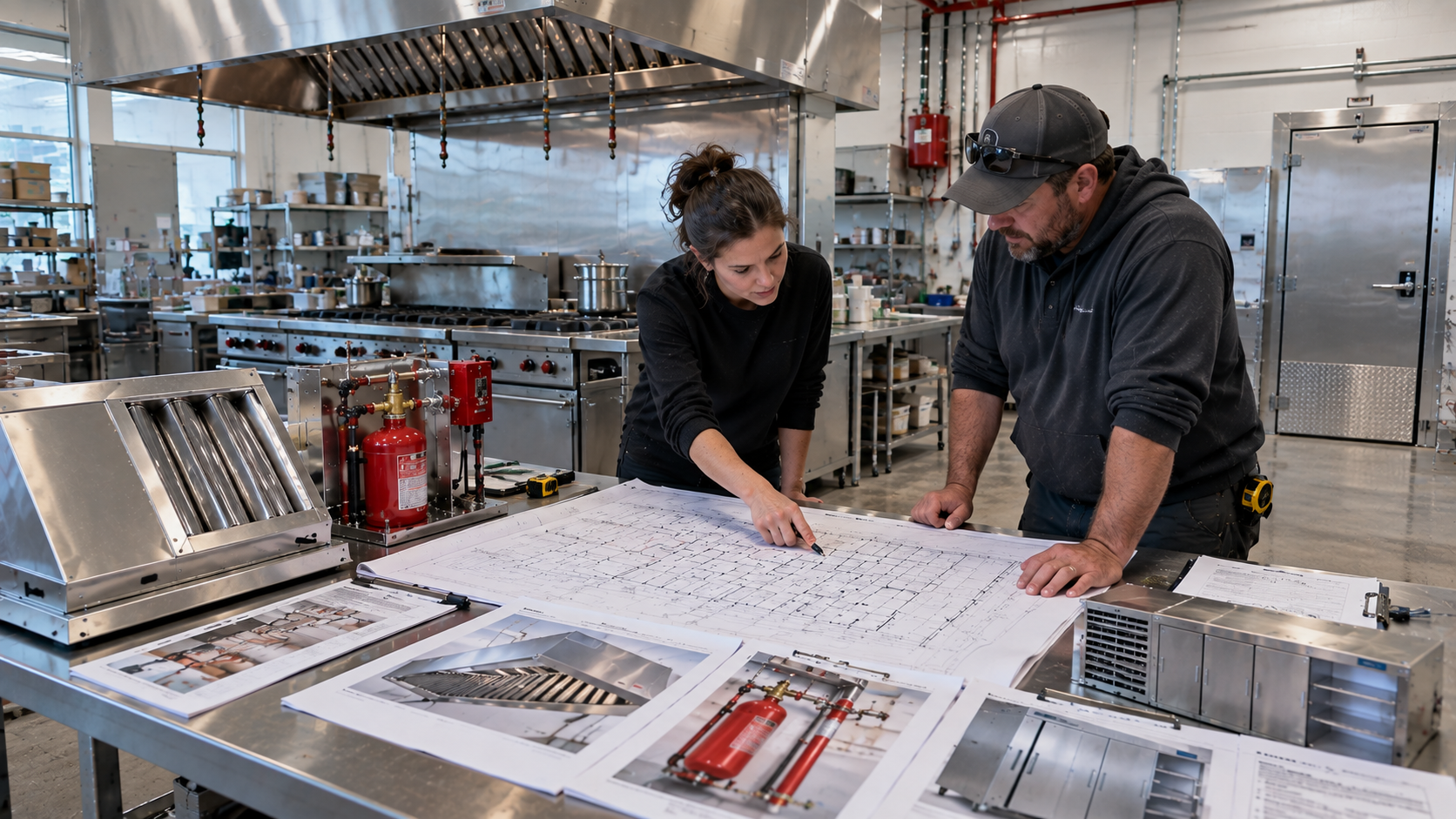
Opening a Restaurant in Virginia: Kitchen Design, Hood, Fire Suppression and Refrigeration Checklist