
PVC for Compressed Air Lines: Is It Safe? What Shenandoah Valley Shop Owners Need to Know
PVC can shatter under compressed air. Here is what the OSHA record says and how VA Commercial Repair Solutions replaces it with RapidAir piping.
VA Commercial Repair Solutions is a Class A mechanical contractor based in Fishersville, Virginia. We are the local RapidAir factory representative and installer of compressed air piping for shops across the Shenandoah Valley and Central Virginia.
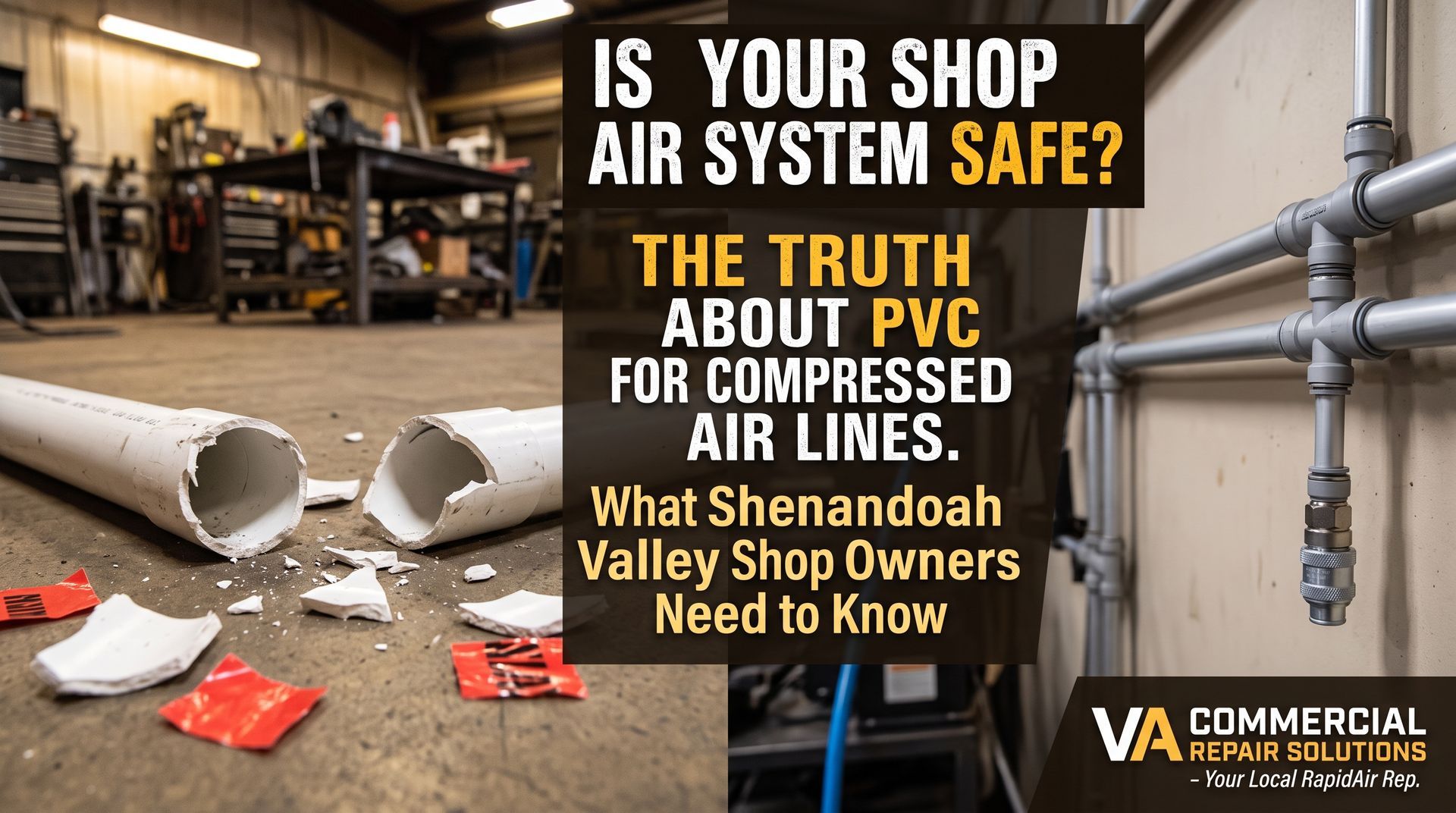
Our answer on PVC for compressed air lines is short. Standard PVC is not safe for above-ground compressed air service. When it fails, it can shatter and throw sharp plastic fragments across a work area. OSHA warned employers about this hazard in a May 20, 1988 Hazard Information Bulletin. As of September 2026, that guidance is still published on OSHA's website.
Why Is PVC for Compressed Air Lines Dangerous?
The danger comes from stored energy. Air compresses, so a pressurized air line holds a lot of energy. Water barely compresses, so a water line holds very little.
Material attached to OSHA's 1988 bulletin on PVC in above-ground installations makes this point directly. Liquids compress by only about one tenth of one percent. When a water pipe fails, its energy dissipates quickly. When a PVC air line fails, that energy is released all at once.
OSHA's bulletin describes the incident that prompted it. A PVC compressed air line ruptured in a Texas plant, and flying plastic cut an employee's hand.
PVC is also a plumbing product. The pressure number printed on schedule 40 pipe describes water service, not compressed gas. VA Commercial Repair Solutions treats any above-ground PVC air line as a hazard to replace, whatever its schedule or age.
What Does OSHA Actually Say About PVC Air Lines?
Some contractor websites say OSHA "banned" PVC for compressed air. The record is more specific than that, and it still points to replacement. VA Commercial Repair Solutions uses the precise wording, because the precise version holds up when an inspector or insurer asks.
The record comes in five pieces:
- May 20, 1988. OSHA issued the bulletin linked above. It cited the Plastics Pipe Institute's Recommendation B from January 19, 1972. That recommendation advised against thermoplastic pipe for compressed air or gas in exposed plant piping.
- December 13, 1990. OSHA issued a follow-up bulletin on thermoplastic pipe in above-ground locations. It noted the Institute's revised recommendation of December 1, 1989. Under that revision, pipe need not be buried or encased if it is made from materials that resist shattering.
- February 28, 1991. OSHA published a standard interpretation on thermoplastic air pipe. It rejected the reading that regular PVC pipe made to ASTM D1785 qualifies. Pipe must be made of, or encased in, shatter-resistant material.
- Piping codes. J. J. Keller's compliance summary points to ASME B31.3 and ASME B31.9. Both codes exclude PVC and CPVC from compressed air service.
- State guidance. The Oregon OSHA fact sheet on compressed air piping warns that PVC can shatter or explode under pressure. It also says plastic air piping must be suited to the specific application.
OSHA also lists the 1988 bulletin as a hazard reference on its compressed gas and equipment hazard page.
The bulletins are guidance documents, not a standalone regulation. Even so, the OSH Act's General Duty Clause requires employers to protect workers from recognized hazards. A hazard OSHA has documented since 1988 is a recognized one.
In Virginia, workplace safety is enforced through the Virginia State Plan administered by the Department of Labor and Industry. Virginia's VOSH program keeps a field office in Verona, a few miles from Staunton.
What Does a Failing PVC Air Line Look Like?
The honest problem with PVC is that it often gives little warning before it fails. PVC fails in a brittle way. It can crack apart without first bulging or leaking.
Some signs still justify a call to VA Commercial Repair Solutions:
- Chalky, yellowed, or faded pipe on runs exposed to sunlight
- Hairline cracks near glued fittings and elbows
- Sagging runs between hangers
- Hissing at joints, which also wastes energy
- PVC air lines in unheated buildings, such as farm shops and equipment barns, where cold makes plastic more brittle
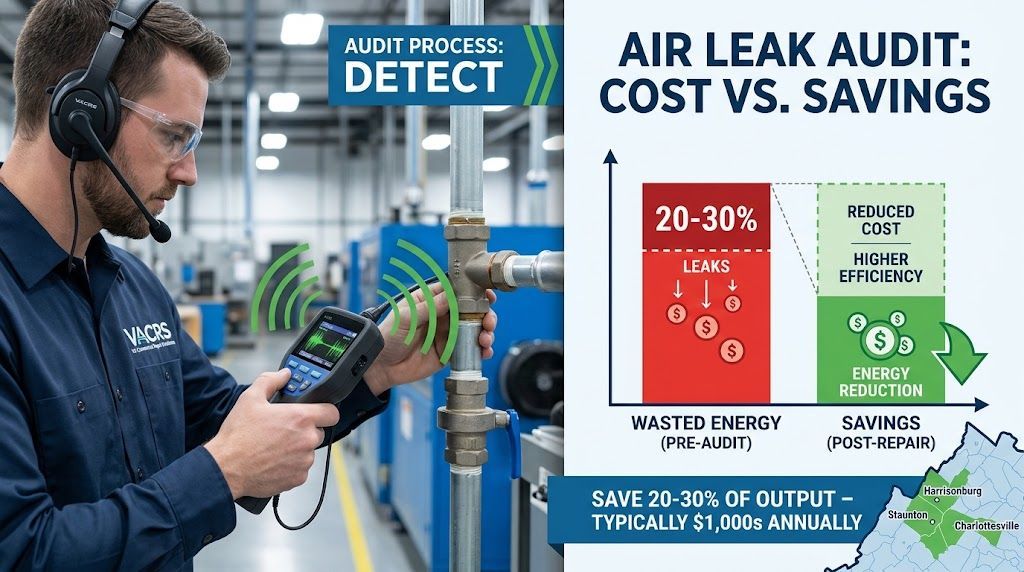
The U.S. Department of Energy's compressed air leak tip sheet lists fittings, pipe joints, and couplings among the most common leak points. On a PVC system, a leaking joint is both a cost problem and a warning sign.
Which Shops in Staunton, Harrisonburg, and Charlottesville Still Run PVC?
PVC tends to show up in systems that were piped quickly, cheaply, or by the owner. VA Commercial Repair Solutions most often sees this risk in a few types of facility across Staunton, Harrisonburg, Charlottesville, Waynesboro, and Lexington:
- Auto repair and body shops that added air drops as they grew
- Farm operations running air to barns and equipment sheds
- Small manufacturers and fabrication shops piped before they had a maintenance contractor
- Breweries and wineries with process air in production rooms, a market we already serve through our microbrewery and vineyard mechanical services
VA Commercial Repair Solutions serves new clients within a 250-mile radius of our Fishersville shop, according to our air compressor maintenance service page.
What Should Replace PVC for Compressed Air Lines?
Several materials are made for compressed air. The right one depends on your budget, air quality needs, and how often your layout changes. VA Commercial Repair Solutions installs RapidAir aluminum and tubing systems and can advise on the others.
RapidAir states that its system cuts installation time and labor by 30 to 50 percent compared with copper or black iron. That is RapidAir's own figure, not independent research.
Other aluminum systems are also sold in Virginia, including through Pattons, the Virginia ELGi distributor. What sets VA Commercial Repair Solutions apart is local service. We install the pipe, and we also maintain and repair the compressor feeding it.
Our RapidAir compressed air piping installation page covers the system, our no-markup parts policy, and our 5-year labor warranty on warrantied parts.
How Does VA Commercial Repair Solutions Assess a PVC Replacement?
A replacement starts with a walk-through of your air system. VA Commercial Repair Solutions checks the whole system, because a new pipe does little good if the compressor feeding it is failing.
The assessment covers:
- Every PVC run, drop, and fitting from the compressor to the point of use
- The compressor, tank, and dryer, handled through our commercial air compressor repair service for 5 to 600 HP units
- Leaks and pressure drop along the existing system
- A replacement quote for RapidAir piping sized to your shop
Parts and installation quotes are always free. We do not mark up RapidAir parts. A manager or owner answers the phone 24 hours a day at (866) 729-2215.
VA Commercial Repair Solutions is SWAM certified, an eVA certified provider, and a Class A contractor under Virginia license 2705180394. Our 15 facts that separate us from other contractors explain how we work.
To schedule an assessment, request a free quote from VA Commercial Repair Solutions or visit our contact page for our Fishersville shop.
Frequently Asked Questions
Is it legal to use PVC pipe for compressed air in Virginia?
No Virginia rule names PVC air lines as permitted, and OSHA guidance says standard PVC should not carry compressed air above ground. OSHA's 1988 bulletin and its 1991 interpretation say pipe must be shatter-resistant or encased. Virginia enforces workplace safety through its VOSH state plan, so replacing PVC is the defensible choice. VA Commercial Repair Solutions recommends replacement for any above-ground PVC air line.
Did OSHA ban PVC for compressed air?
OSHA did not issue a standalone regulation banning PVC. Instead, it published a 1988 Hazard Information Bulletin warning against PVC for above-ground compressed gas, followed by a 1990 update and a 1991 interpretation. Together they say pipe must resist shattering or be encased. Because the hazard is documented, OSHA can treat it as a recognized hazard under the General Duty Clause.
What pressure can PVC handle for compressed air?
No pressure is safe for PVC in above-ground compressed air service. The rating printed on schedule 40 PVC describes water, which stores very little energy under pressure. Compressed air stores far more, and PVC fails by shattering rather than leaking. That is why OSHA guidance and the ASME B31.3 and B31.9 piping codes exclude standard PVC from compressed air service.
Is buried PVC okay for compressed air?
OSHA's 1990 bulletin notes that the Plastics Pipe Institute's recommendation allows buried or encased thermoplastic pipe, since surrounding material contains fragments. Buried lines still age, leak, and become hard to inspect or repair. VA Commercial Repair Solutions recommends a pipe rated for compressed air service wherever a line runs above ground or enters a building.
What is the best pipe for a shop compressed air system?
For most shops, aluminum compressed air pipe such as RapidAir is the best balance of cost, clean air, and flexibility. It does not rust like black iron, it needs no soldering like copper, and drops can be added later. Stainless steel suits process air where cleanliness matters most. VA Commercial Repair Solutions installs RapidAir systems across Central Virginia.
How much does it cost to replace PVC air lines?
Cost depends on total footage, the number of drops and fittings, pipe diameter, and how hard the run is to reach. Aluminum costs more per foot than black iron, but RapidAir states it takes 30 to 50 percent less installation time. VA Commercial Repair Solutions provides free parts and installation quotes and does not mark up RapidAir parts.
Who installs RapidAir compressed air piping near Staunton, Harrisonburg, or Charlottesville?
VA Commercial Repair Solutions, based in Fishersville, Virginia, is the local RapidAir factory representative and installer for Staunton, Harrisonburg, Charlottesville, Waynesboro, and Lexington. The company also maintains and repairs air compressors of all brands. A manager or owner answers calls 24 hours a day at (866) 729-2215, and quotes are free.
Sources and Retrieval Dates
All sources retrieved September 26, 2026.
- OSHA Hazard Information Bulletin, May 20, 1988: osha.gov/publications/hib19880520
- OSHA Hazard Information Bulletin, December 13, 1990: osha.gov/publications/hib19901213
- OSHA Standard Interpretation, February 28, 1991: osha.gov/laws-regs/standardinterpretations/1991-02-28
- OSHA Compressed Gas and Equipment hazard page: osha.gov/compressed-gas-equipment/hazards
- OSHA Virginia State Plan: osha.gov/stateplans/va
- Oregon OSHA Fact Sheet on compressed air piping: osha.oregon.gov/OSHAPubs/factsheets/fs44.pdf
- J. J. Keller Compliance Network, ASME B31.3 and B31.9 summary: jjkellercompliancenetwork.com
- U.S. DOE Compressed Air Tip Sheet #3: energy.gov
- RapidAir installation time figure: RapidAir claim as stated on vacommercialhvac.com
Spot an error? Email VACommercialRepair@gmail.com and we will correct it.

Opening a Restaurant in Virginia: Kitchen Design, Hood, Fire Suppression and Refrigeration Checklist