
Step-by-Step Ice Maker Repair for Commercial Kitchens
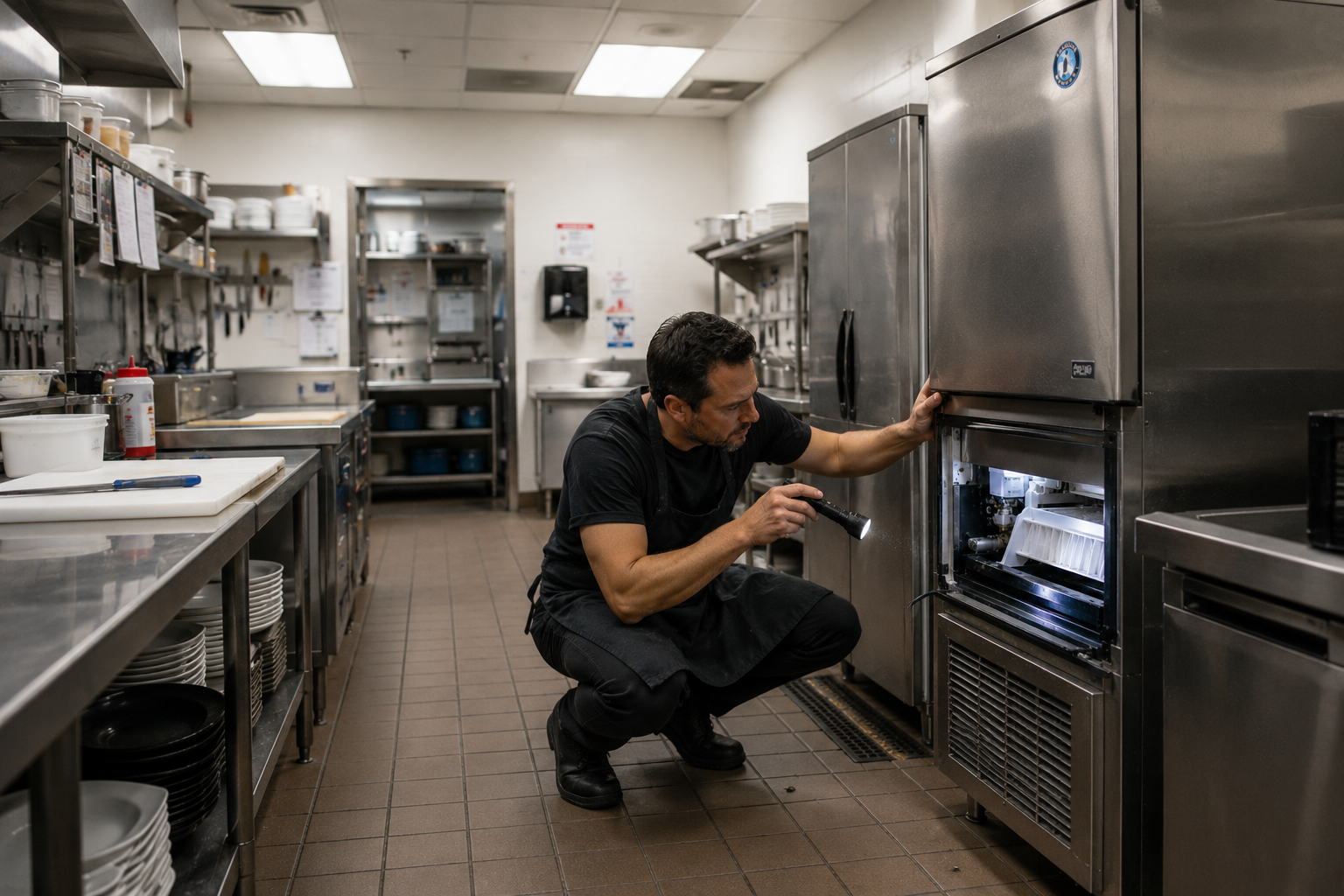
A commercial ice maker that stops producing is one of the fastest ways to lose revenue in a food-service operation. Bars run out of ice mid-shift. Restaurants can't serve drinks. Hotels disappoint guests during peak season.
The problem compounds quickly. A food-service kitchen running without ice for even four hours faces real financial damage — lost drink sales, guest complaints, and health-code pressure if ice-dependent food storage is affected.
This guide walks through every step of commercial ice maker repair. Some checks you can perform yourself. Others require a licensed technician with refrigerant-handling certification and specialized diagnostic tools.
What Makes Commercial Ice Maker Repair Different?
A commercial ice machine isn't a scaled-up version of the one in your home refrigerator. It runs continuous refrigerant cycles, processes dozens of gallons of water per day, and operates under constant load in a hot kitchen environment.
The result is a repair process that's more complex than almost any other piece of kitchen equipment. Misdiagnosis is common — and expensive. A technician who swaps parts without isolating the actual failure point sends you back to a non-producing machine within weeks.
CFESA trains and certifies technicians specifically for commercial food service equipment repair. When vetting a contractor for ice machine work, CFESA membership or factory brand certification is a meaningful credential — not just a marketing claim.
Commercial ice machines also require EPA Section 608 certification for any work involving the refrigerant circuit. This isn't optional. Federal regulations prohibit refrigerant handling, recovery, and recharge by anyone without that credential. Verify your technician holds it before any refrigerant work begins.
Before You Start: Safety and What You'll Need
Safety first: Turn off the disconnect switch — not the control switch — before touching any internal components. The control switch cuts the ice cycle but leaves the unit powered. Only the disconnect switch removes power entirely.
What you'll need:
- Towels and a bucket — water will be present, especially mid-cycle
- Flashlight — internal components are typically in dark bottom sections
- Multimeter — for basic electrical checks on valves and solenoids
- Water-quality test strips — useful if hard water is a known issue in your facility
Before you call a technician, document:
- Was production declining gradually, or did it stop suddenly?
- Was ice quality poor (thin, hollow, misshapen) before output stopped?
- Any recent maintenance, moves, or service visits?
That information helps a technician diagnose faster and reduces your service bill.
Step 1: Check Power and Water Supply
Start at the source. A significant share of commercial ice machine service calls trace back to power or water supply issues — not internal machine failure.
Go to the electrical panel and check the circuit breaker feeding the unit. A tripped breaker is an immediate fix. If it trips again immediately after reset, stop — a recurring trip signals an overload or electrical fault that requires a licensed electrician.
Check the disconnect switch at the unit itself. These are frequently left in the off position after maintenance visits and overlooked entirely. Also confirm the machine's power switch is in the on position and not stuck in a fault-hold state.
On the water side, verify the supply valve is fully open. A partially closed valve reduces incoming water pressure, which leads to thin ice, hollow cubes, or the machine entering a pause cycle. Check the water supply line for kinks, especially if the machine was recently moved or serviced.
Step 2: Perform a System Reset
Commercial ice machines have a control board that logs fault conditions and locks the machine out when it detects a problem. When the machine fails, a deliberate reset sequence is required to clear the fault and restart.
Turn the power switch off. Allow all ice on the evaporator to melt completely before proceeding — this may take 20 to 30 minutes depending on the machine and ambient temperature. Don't skip this step. Restarting with ice still on the evaporator triggers an immediate fault.
Unplug the machine from its power source for at least 10 seconds. Reconnect power and restart. If the machine begins a normal freeze cycle, monitor it through at least two complete cycles before considering the issue resolved.
A machine that restarts but fails within two cycles has an underlying fault the reset temporarily cleared. Note any error codes or fault lights displayed on the control panel — most commercial machines from Hoshizaki, Manitowoc, and similar brands display specific fault codes that narrow the diagnosis significantly.
Step 3: Clean the Condenser Coils
Dirty condenser coils are the most overlooked cause of reduced ice production in commercial kitchens. The condenser is where the machine expels heat from the refrigerant circuit. When coils are coated in grease, dust, or kitchen debris, the machine can't reject heat effectively.
Reduced heat rejection raises head pressure throughout the refrigerant circuit. High head pressure forces the compressor to work harder and reduces cooling capacity across every freeze cycle. In hot commercial kitchen environments, a fouled condenser can cut ice production by 30% or more before the machine eventually fails entirely.
Turn off power before cleaning. For air-cooled machines, use a commercial coil cleaning brush and work from the inside of the coil face outward to push debris out rather than deeper in. Never use a pressure washer — condenser fins are fragile aluminum and bend easily, which reduces airflow permanently.
For water-cooled machines, the condenser is a water-to-refrigerant heat exchanger rather than an air-cooled coil. Scale buildup inside the water circuit reduces heat transfer. Water-cooled condenser cleaning requires a licensed technician and specific descaling chemicals.
Step 4: Inspect and Replace the Water Filter
A clogged water filter restricts flow to the water distribution system above the evaporator. The machine produces thin, hollow, or misshapen ice before stopping altogether. Hard water locations see filters clog far faster than the manufacturer's replacement schedule assumes.
Remove the filter and hold it up to a light source. If you can't see light through the filter medium, replace it immediately. While the filter is out, inspect the filter housing for scale buildup or biofilm inside the housing walls. Clean the housing before installing the new filter.
Water hardness has a direct impact on filter life and evaporator scale accumulation. The NSF/ANSI 12 standard for commercial ice machines recommends incoming water hardness below 10 grains per gallon for most equipment. If your facility consistently exceeds that, a water softener or inline scale inhibitor extends filter life and protects the evaporator.
Also check water temperature entering the machine. Most commercial ice machines are rated at incoming water temperatures around 50°F. Warmer incoming water significantly slows freeze cycles and reduces daily ice output capacity. If your water is coming in consistently above 60°F, the rated output on the machine's nameplate doesn't reflect your actual production potential.
Step 5: Inspect the Water Inlet Valve
The water inlet valve controls water flow into the machine at the start of each freeze cycle. A valve stuck closed produces no water and no ice. A valve stuck partially open causes continuous water flow that can flood the bin, trigger the drain, or prevent proper ice formation.
With power off, disconnect the water line at the inlet valve and inspect the screen for debris or scale. The inlet valve screen is a common clog point in hard-water locations. Clean it carefully with a soft brush and clean water. Reinstall and test.
If the screen is clear but the valve isn't opening during a freeze cycle, test the solenoid coil with a multimeter. A failed solenoid reads open — no continuity between the terminals. That confirms valve replacement. Inlet valve replacement is a straightforward repair most licensed technicians can complete in a single visit with a stocked parts inventory.
Some commercial ice machines use multiple water inlet valves — one for the main fill circuit and one for the purge cycle that dumps mineral-concentrated water at the end of each freeze. Test both if your model has them.
Step 6: Check the Float Switch and Bin Control
The bin control sensor tells the machine when the storage bin is full. When it reads full — even with an empty bin — the machine stops production and waits. A misaligned, damaged, or ice-covered bin control is a common cause of premature production stoppage.
With power off, inspect the bin control sensor for ice accumulation, physical damage, or misalignment. Clear any ice blocking the sensor's detection path. On thermistor-style bin controls, confirm the sensor is making firm contact with its designated sensing surface. Thermistors that have pulled away from the surface read incorrect temperatures.
The float switch monitors water level in the reservoir. A stuck float arm causes the machine to read the reservoir as full when it's empty, stopping the water fill cycle before the freeze cycle can start. With power off, manually depress and release the float arm to confirm it moves freely through its full range. If it feels sticky or catches, clean the reservoir and check for scale binding the float pivot.
Step 7: Examine the Evaporator and Harvest Cycle
The evaporator is the refrigerated surface where ice forms. Mineral scale on the evaporator reduces contact between water and the refrigerated surface, producing slow freeze cycles, thinner ice sheets, or ice that won't release cleanly at harvest.
Commercial ice machines require deliming at intervals determined by your water hardness. Most manufacturers recommend deliming every six months at minimum. Quarterly deliming is appropriate for hard-water locations or high-volume operations.
Manitowoc's maintenance guidelines specify descaling procedures by model, including correct descaler concentration and dwell time. Follow the manufacturer's procedure exactly — using the wrong concentration or contact time damages the evaporator coating.
A harvest failure — where ice forms correctly but doesn't release from the evaporator — points to the hot gas harvest valve, a refrigerant imbalance, or a control board timing fault. The harvest valve opens briefly to push warm refrigerant gas back through the evaporator, warming it just enough to release the ice slab. A failed harvest valve stays closed and the ice never drops. Testing harvest valve function requires manifold gauges and refrigerant circuit access — a licensed technician task.
Step 8: Diagnose the Refrigerant Circuit
This step requires a licensed refrigeration technician. Do not attempt refrigerant circuit diagnosis or repair without EPA Section 608 certification. Refrigerant circuit issues in ice machines typically appear as long freeze cycles, soft or undersized ice, or a machine entering a safety lockout after running without completing a harvest.
A technician will connect manifold gauges to the service ports and read suction and discharge pressures while the machine runs. They compare those readings to the machine's published design pressures for your ambient conditions. Deviation from spec identifies whether the issue is a low charge, a refrigerant leak, or a refrigerant restriction.
If a leak is confirmed, the source must be found and repaired before the system is evacuated and recharged. Recharging a leaking system is illegal under EPA Section 608 and is a short-term fix at best. The refrigerant will escape again, and the second failure usually causes compressor damage from running in a low-charge condition.
When an Ice Maker Can't Be Repaired
Some ice machine failures lead directly to replacement. Knowing the difference saves time and prevents wasted repair investment.
A failed compressor — one that tests open (ohms to infinity) or shorted to ground — cannot be repaired in the field. Compressor replacement on a commercial ice machine is often cost-prohibitive, especially on units over 7 years old. The cost of a replacement compressor plus labor frequently approaches or exceeds the cost of a new unit.
A refrigerant leak in an aluminum evaporator coil is also irreparable in the field. Copper refrigerant tubing can be brazed and repaired. Aluminum cannot. VA Commercial Repair Solutions — with 17+ years in commercial refrigeration and kitchen equipment across central Virginia — identifies these failure types upfront. They show customers the meter readings and inspection results rather than simply asserting that replacement is needed.
Preventive Maintenance Schedule
Consistent preventive maintenance is what separates a commercial ice machine that lasts 12 years from one that fails in five. Use this table as your baseline — adjust condenser cleaning frequency based on how much grease and dust your kitchen generates.
| Environment | Full Clean (bin, filter, evaporator) | Condenser Cleaning |
|---|---|---|
| Standard commercial kitchen | Every 6 months | Every 6 months |
| High-volume (hotel bar, stadium, busy restaurant) | Quarterly | Every 3 months |
| Grease-heavy kitchen (near fryer or grill) | Every 6 months | Every 2–3 months |
| Low-load environment (hotel utility room, office) | Every 6 months | Every 6 months |
The FDA Food Code requires food contact surfaces — including ice machine interiors — to be free of soil and microbial contamination. Biofilm, slime, and scale are all citation material during a health inspection.
VA Commercial Repair Solutions offers ice maker maintenance plans that put all of this on a fixed calendar. Cleaning visits, filter changes, and evaporator descaling are scheduled in advance. Emergency dispatch for breakdowns between visits is included. For operators managing multiple ice machines across a facility, a maintenance plan is significantly cheaper than emergency service calls.
Common Questions About Commercial Ice Maker Repair
How do I know if my problem is refrigerant-related or mechanical?
Refrigerant issues typically produce long freeze cycles, soft or undersized ice, or a machine that runs continuously without completing a harvest. Mechanical issues — stuck valves, failed harvest motors, blocked water lines — usually cause a more abrupt stop. A technician can distinguish between the two with manifold gauges in the first 15 minutes on-site.
Can I clean my commercial ice machine myself?
The bin interior and water distribution components can be cleaned using the manufacturer's recommended ice machine cleaner and sanitizer. Condenser coil cleaning and evaporator descaling should be handled by a certified technician. Using incorrect chemicals or concentrations on the evaporator coating causes permanent damage.
How long should a commercial ice machine last?
With consistent preventive maintenance, commercial ice machines from brands like Hoshizaki and Manitowoc routinely reach 10 to 15 years of service life. Without regular cleaning and filter replacement, scale accumulation shortens that to five to seven years. The difference is almost entirely maintenance discipline.
What size ice machine does a commercial kitchen need?
A general industry guideline is 1.5 pounds of ice per restaurant seat per day for table-service operations. Bars typically need 3 pounds per seat. Ice machine capacity ratings are given in pounds per 24-hour period — but always verify that the rating is based on ambient temperatures that reflect your actual kitchen environment, not lab conditions.
Why does the machine keep entering pause mode with an empty bin?
A machine that pauses with an empty bin almost always has a bin control fault. The sensor is either misaligned, covered with ice, or reading incorrect temperatures. Check the sensor position and clear any ice obstruction first. If the problem persists, a technician can test the sensor's resistance output against the manufacturer's spec chart.
What do I do while waiting for a technician during peak hours?
Call for emergency service immediately — don't wait to see if the machine recovers on its own. Source bagged ice from a local supplier to keep service running while you wait. VA Commercial Repair Solutions offers mobile freezer and refrigerator rental for facilities facing extended downtime. The cost of a day's rental is almost always less than the cost of a shift's worth of lost drink revenue.
Conclusion: Diagnose Systematically, Then Maintain Consistently
A commercial ice maker that stops producing costs money every hour it's down. The difference between a same-day fix and a multi-day repair is almost always systematic diagnosis — working through each layer instead of guessing at the most likely cause.
Most commercial ice machine failures trace to one of five sources: a dirty condenser, a clogged water filter, a failed inlet valve, scale on the evaporator, or a bin control fault. All five are diagnosable in a single visit by a qualified technician. What's not repairable — failed compressors and aluminum coil leaks — can be identified quickly if the technician knows what to check.
For commercial kitchens in central Virginia and the Shenandoah Valley, VA Commercial Repair Solutions covers ice maker repair, cleaning, and preventive maintenance under one Class A license. They hold preferred-service relationships with Hoshizaki, Manitowoc, True, CaptiveAir, and TurboAir. Schedule a service call — live phone 24/7, 85% first-visit fix rate, and a written $50 guarantee if the repair can't be completed.
Opening a Restaurant in Virginia: Kitchen Design, Hood, Fire Suppression and Refrigeration Checklist