
Step-by-Step Guide to Commercial Kitchen Hood Installation
Why Professional Commercial Kitchen Hood Installation Is Critical for Your Business

Commercial kitchen hood installers are essential for ensuring your restaurant's ventilation system meets safety codes and operates efficiently. The right installation protects your staff, customers, and investment from fire hazards while maintaining compliance with health regulations.
What to Look for in Commercial Kitchen Hood Installers:
- Licensed and certified technicians with NFPA 96 training
- Live-answered calls for immediate response (no voicemail runaround)
- Complete service offering including permits, installation, and fire suppression
- Local experience with Virginia building codes and inspections
- Warranty coverage on both equipment and installation work
- 24/7 emergency support to minimize business downtime
Most commercial kitchen hood installation projects are completed within 1-2 weeks, with professional installation of a standard hood system typically taking about 60 minutes for simple setups.
Poor installation leads to serious problems: increased fire risk, health department violations, insurance claims being denied, and costly equipment repairs. Restaurant owners who cut corners often face emergency shutdowns during peak business hours.
The installation process involves precise calculations for airflow (CFM), proper duct routing, fire suppression integration, and thorough testing to ensure your system removes grease-laden vapors effectively.
I'm Gregg Kell from VA Commercial Repair Solutions, and I've helped dozens of Central Virginia restaurants steer commercial kitchen ventilation systems. My experience with commercial kitchen hood installers has shown me that choosing the right professional makes the difference between a smooth installation and costly headaches.

What Is a Commercial Kitchen Hood & Why It Matters
A commercial kitchen hood is your restaurant's silent guardian - a sophisticated ventilation system that keeps your kitchen safe, your staff comfortable, and your business compliant with health codes.
The hood system includes the stainless steel canopy above your cooking equipment, powerful exhaust fans, ductwork that routes air outside, and often fire suppression components. When everything works together properly, it creates negative pressure that pulls grease-laden vapors, heat, smoke, and cooking odors up and away from your kitchen.
Properly sized commercial hoods move hundreds or thousands of cubic feet of air per minute (CFM). Without a properly installed hood system, you're facing serious risks. Grease-laden vapors are highly flammable - they accumulate on surfaces and in ductwork, creating fire hazards that can destroy your business.
Health departments require commercial kitchen ventilation to meet sanitation standards and protect food safety. The system also removes smoke and steam that would make your kitchen unbearable for staff and spread unwanted odors to your dining areas.
Grease buildup on your expensive kitchen equipment shortens its lifespan and increases maintenance costs. A good ventilation system pays for itself by protecting your investment.
The NFPA standards for commercial kitchens aren't suggestions - they're requirements. NFPA 96 is the national standard that governs ventilation control and fire protection for commercial cooking operations. Commercial kitchen hood installers who understand these codes are essential for keeping your business compliant.

Types of Hoods & Their Applications
Type I hoods are your heavy-duty workhorses. These grease hoods handle any cooking appliance that produces grease-laden vapors - fryers, broilers, grills, and woks. They feature grease filters, integrate with fire suppression systems, and require higher CFM rates.
Type II hoods are the lighter-duty option for non-grease-producing appliances like steamers, dishwashers, and ovens. These condensate hoods handle steam and moisture without needing grease filters or fire suppression integration.
Ventless hoods offer flexibility when traditional ductwork isn't practical. These self-contained units filter and recirculate air back into the kitchen, working well for food trucks and light-duty cooking applications.
Hood configurations include wall-mounted canopy hoods (most common), island canopy hoods for center cooking stations, and proximity hoods for space-saving applications.
Size selection matters. Standard hood width is 30 inches to match typical commercial ranges, though custom sizing is common. To calculate required CFM, a basic formula is CFM = 2 × kitchen square footage, though professional load calculations consider cooking equipment types and local codes. This is where experienced commercial kitchen hood installers prove their worth.
Choosing Commercial Kitchen Hood Installers
Finding the right commercial kitchen hood installers will impact your restaurant's safety, compliance, and daily operations for years to come. Choose poorly, and you'll face code violations, safety hazards, and the nightmare of starting over.
Essential credentials include a valid state HVAC contractor license, fire suppression system certification , NFPA 96 training , UL and NSF certifications, and solid local building code knowledge .
At VA Commercial Repair Solutions, we maintain all required certifications and provide live-answered calls - no voicemail delays when you need immediate assistance. Our Local Heroes for Your Commercial Kitchen Hood Installation approach means we understand Virginia's specific requirements and work directly with local inspectors.
Red flags to avoid: contractors without proper licensing, quotes that seem too good to be true, unwillingness to pull permits, no insurance verification, poor communication, and lack of local references.
Key Factors Before Hiring Commercial Kitchen Hood Installers
Permits and inspections should be handled completely by your contractor, including building permits, mechanical permits, electrical permits, and fire department approvals. If they're asking you to handle paperwork, that's a red flag.
Insurance protection is non-negotiable. Your contractor needs general liability insurance with at least $1 million coverage, workers' compensation coverage, bonding for project protection, and equipment coverage during installation.
References tell the real story about work quality. Request recent local projects and actually call those references. Ask about project completion schedules, code compliance, inspection results, and overall satisfaction.
Warranty coverage separates professional installers from fly-by-night operators. Quality work comes with comprehensive warranties covering installation workmanship (typically 1-2 years), equipment warranties, fire suppression components, and electrical integration.
Our Commercial Kitchen Hood Vent Installation Tips emphasize getting detailed contracts that specify warranty terms, project timelines, and service commitments.
Questions to Ask Commercial Kitchen Hood Installers
About pricing: Ask "What exactly is included in your price?" Find out if permits and inspections are included, what potential additional costs to expect, and whether they offer financing options.
Technical expertise: Ask how they calculate required CFM for your specific kitchen, what make-up air requirements your system will need, and how they'll integrate fire suppression with hood controls.
Code compliance: Ask if they're familiar with Virginia Mechanical Code requirements, how they ensure NFPA 96 compliance, and what documentation they'll provide for inspections.
Post-installation support: Ask what maintenance services they provide, how quickly they can respond to emergency repairs, and whether they offer maintenance contracts.
Quality contractors welcome these questions and provide detailed, confident answers. If someone gets evasive or pressures you to sign quickly, keep looking.
Step-by-Step Installation Process (From Site Survey to Final Inspection)
Professional commercial kitchen hood installers follow a systematic approach that ensures everything works perfectly from day one. The process requires coordination of multiple trades and inspections.
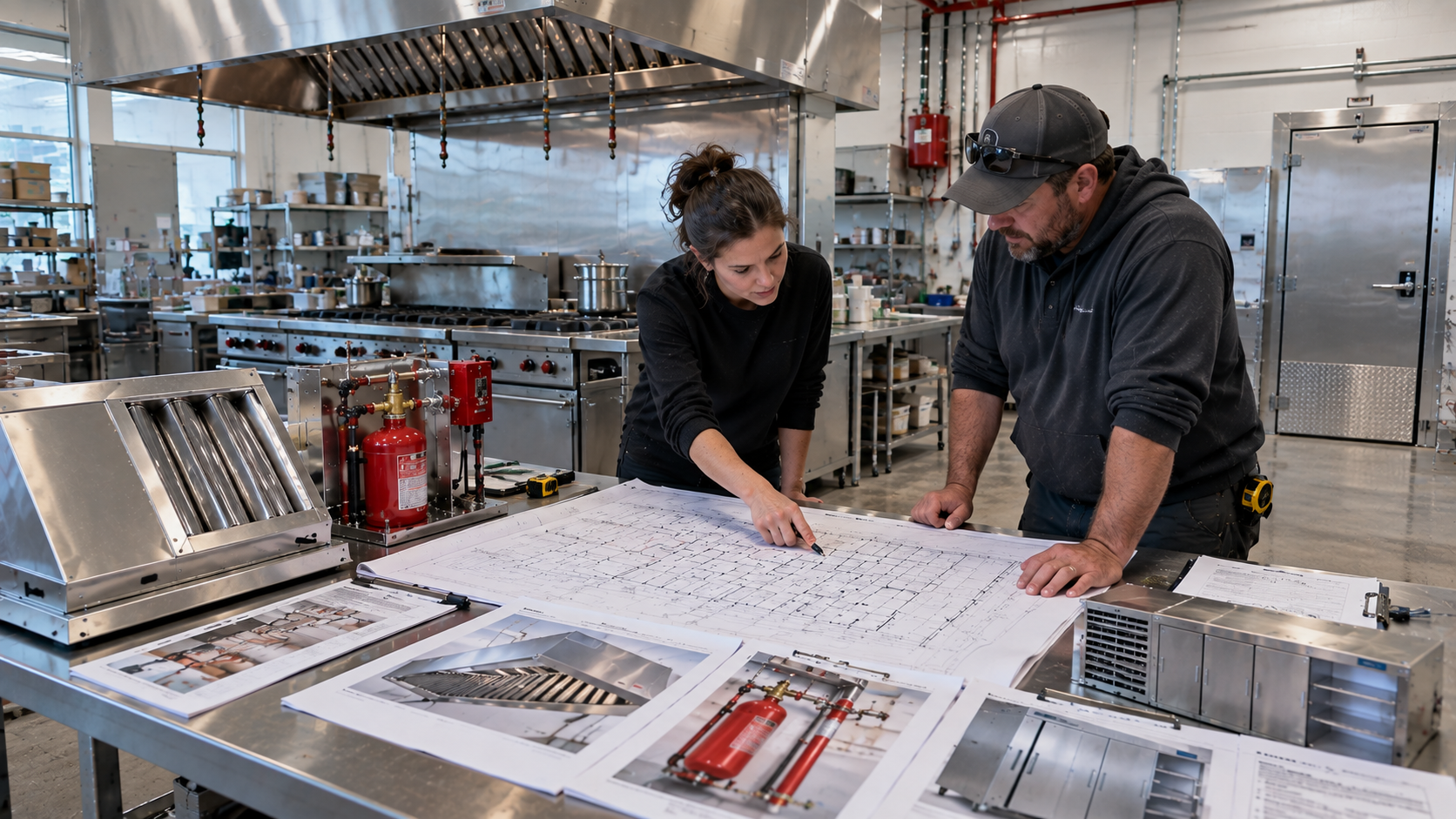
The journey starts with our comprehensive site assessment . We measure your kitchen, noting ceiling height, cooking equipment placement, and structural elements. We examine your cooking equipment's heat output, plan efficient ductwork routing, and evaluate electrical upgrade needs.
Engineering and permit work involves calculating precise CFM requirements based on actual equipment loads, designing ductwork to optimize airflow, handling all permit applications, and coordinating with the fire marshal for suppression system approval.
Equipment procurement includes sourcing UL-listed hoods with proper grease filters, correctly rated exhaust fans, insulated double-wall ductwork for fire safety, properly sized make-up air units, and code-compliant fire suppression systems.
The physical installation typically takes one to two days for standard systems. Day one focuses on structural and mechanical work - installing roof penetrations, mounting the hood canopy, positioning exhaust fans and make-up air units, and running electrical connections.
Day two brings integration and testing . The fire suppression system gets installed and tested, control systems are programmed with proper interlocks, and we perform comprehensive air balance testing.
Testing and commissioning involves measuring airflow at every point, conducting fire suppression activation tests, verifying electrical controls, and testing all safety interlocks. Every test result gets documented for inspection purposes.
The final inspection phase involves coordinating building department mechanical approval, fire marshal suppression system verification, health department ventilation checks, and utility company inspections. We handle scheduling and are present for every inspection.

| Installation Aspect | DIY/Handyman | Professional Installation |
|---|---|---|
| Permit handling | Owner responsibility | Contractor manages all permits |
| Code compliance | Risk of violations | Guaranteed compliance |
| Installation time | 3-5 days typical | 1-2 days for most systems |
| Warranty coverage | Equipment only | Full system warranty |
| Fire suppression | Separate contractor needed | Integrated installation |
| Cost (4' hood system) | $3,500-5,000 + labor issues | $6,000-8,000 complete |
Sample Timeline & Cost Factors
Timeline expectations: site survey and planning (1-2 days), permit approval (1-2 weeks), equipment procurement (3-5 business days), actual installation (1-2 days), inspections and final approval (3-5 days). Total project duration: 2-3 weeks for most installations.
Cost factors vary significantly. According to HoodMart | Commercial Range Hoods, a basic 4' x 48" hood package starts at $3,507.70, with fire suppression packages beginning at $6,275.43.
Installation variables affecting pricing include kitchen size and complexity, ductwork length and routing challenges, structural modifications required, electrical panel upgrades needed, and make-up air system requirements. Additional considerations include permit fees (typically $200-800), crane service for rooftop installations, and custom fabrication requirements.
Common Mistakes & How to Avoid Them
Undersized hood systems top the list - installing hoods too small for cooking equipment leads to poor ventilation, grease buildup, and code violations. Professional load calculations based on actual equipment heat output prevent this.
Improper clearances create fire hazards and insurance problems. Following NFPA 96 clearance requirements and manufacturer specifications prevents these issues.
Skipping make-up air systems causes negative pressure problems. Properly sized make-up air units solve this completely.
Poor documentation causes failed inspections and warranty issues. We provide complete documentation packages with test results that satisfy any inspector.
The difference between professional commercial kitchen hood installers and cut-rate contractors shows up in these details.
Post-Installation Care: Maintenance, Cleaning & Fire Safety
Your commercial kitchen hood installation is just the beginning. Grease removal isn't just about cleanliness - it's about preventing buildup that turns your ventilation system into a fire hazard.
Service intervals depend on usage. A 24-hour diner needs monthly cleaning, casual restaurants can stretch to quarterly service, and light-cooking cafes might manage every six months. High-volume operations create more grease-laden vapors, requiring more frequent cleaning.
Filter replacement follows similar patterns. Stainless steel filters should be cleaned monthly and replaced when showing wear. Aluminum filters need replacement every 3-6 months, while charcoal filters in ventless systems require replacement every 2-3 months.
Fire suppression inspections are non-negotiable. Code requires semi-annual professional inspections, and if your system ever activates, you'll need immediate recharging before reopening.
Our Exhaust Hoods and Exhaust Fans service tracks your system's needs and reminds you when service is due.
Energy efficiency improves with proper maintenance. Clean systems don't work as hard, meaning lower utility bills and longer equipment life.

Maintaining Compliance & Performance
Scheduled cleanings go beyond what kitchen staff can handle. Professional services use specialized equipment to reach inside ductwork, steam cleaning to cut through baked-on grease, and eco-friendly chemicals that are tough on grease but safer for staff.
Record keeping becomes crucial when health inspectors arrive. You need documentation of every cleaning, filter change, fire suppression inspection, and system repair.
Staff training makes a huge difference. Your team should know how to handle daily cleaning, when to replace filters, and how to spot problems before they become emergencies.
Emergency repairs can't wait. We offer 24/7 emergency service because ventilation system failures can shut you down immediately.
Role of Fire Suppression Systems
Fire suppression is the last line of defense between a small kitchen fire and total loss. ANSUL systems use wet chemicals specifically formulated to knock down cooking fires and prevent re-ignition.
Nozzle placement requires expertise that only experienced commercial kitchen hood installers possess. Each cooking appliance needs proper coverage, with nozzles positioned to reach every surface where fires might start.
Semi-annual testing ensures systems work when needed. Following UL certification guidelines, inspections verify heat detector calibration, nozzle cleanliness, and electrical interlock function.
Recharging after any activation is mandatory before reopening. The integration between fire suppression and hood controls shuts off gas valves, activates exhaust fans, and triggers emergency systems when every second counts.
Frequently Asked Questions about Commercial Kitchen Hood Installers
How much does professional installation cost?
For a standard 4-foot Type I hood system in Central Virginia, expect $6,000 to $8,000 for basic installation including hood, ductwork, and exhaust fan.
With fire suppression (required for grease-producing equipment), expect $10,000 to $15,000 for a complete system. Complex installations like island hoods can reach $15,000 to $25,000 or more .
Cost drivers include equipment selection, ductwork complexity, structural modifications, electrical upgrades, and fire suppression integration. Permit fees typically run $200 to $800 . We provide detailed quotes breaking down every cost.
How long does a typical install take?
Installation work: Simple wall-mounted systems take about 60 minutes to mount, though we're usually on-site for a full day. Standard systems require 1 to 2 days , while complex multi-hood systems might take 3 to 5 days .
Complete project timeline: Site survey and planning, permit approval (1-2 weeks), equipment procurement (3-5 days), installation, then testing and inspections.
Total project duration: 2 to 3 weeks for standard installations, 4 to 6 weeks for complex systems. We coordinate all phases to minimize business disruption.
What maintenance is required after installation?
Daily: Visual inspection and basic cleaning by kitchen staff.
Monthly: Filter cleaning/replacement and accessible grease removal.
Quarterly: Professional deep cleaning of hood and ductwork, exhaust fan inspection, and system performance verification.
Semi-annually: Fire suppression system inspection, complete system testing with documentation, and comprehensive professional maintenance.
We offer maintenance contracts that handle all required services and keep you compliant with health and fire codes. Regular maintenance prevents expensive emergency repairs and extends equipment life.

Conclusion
Choosing the right commercial kitchen hood installers protects your entire business. From fire safety to health code compliance, your hood system affects everything from staff comfort to insurance coverage. Wrong installation can shut down your restaurant during your busiest night.
Professional installation with experienced, certified technicians is absolutely essential. Improperly installed hoods don't just fail inspection - they put lives at risk and threaten your livelihood.
At VA Commercial Repair Solutions, we've been helping Central Virginia restaurants steer these challenges for years. When you call, you'll reach a real person - not a voicemail system. We know that when your ventilation system has problems, every minute counts.
Our repair-first philosophy saves you money when problems arise. While others push expensive replacements, we fix what can be fixed and only recommend new equipment when truly necessary.
Our comprehensive approach covers everything from initial site surveys and permit handling to final inspections and ongoing maintenance. We coordinate with local inspectors, handle fire suppression integration, and provide documentation you need to stay compliant.
Whether you're opening a new restaurant in Charlottesville, upgrading an existing system in Harrisonburg, or dealing with emergency repairs in Staunton, our 24/7 service means you're never left scrambling. Our Commercial Kitchen Range Exhaust Hood Installation services include comprehensive warranties that protect your investment.
Your restaurant's ventilation system works hard every day to keep your kitchen safe and compliant. Don't gamble with inexperienced installers or bargain-basement contractors who disappear when problems arise.
Contact us today for a thorough evaluation of your commercial kitchen hood needs. We'll walk you through the entire process, answer all your questions, and provide a detailed quote covering everything from permits to final inspection.
Opening a Restaurant in Virginia: Kitchen Design, Hood, Fire Suppression and Refrigeration Checklist